Carbon Fiber's Quiet Takeover in Rackets, Clubs, and Bike Frames
Written by Erik Lange · Apr 14, 2026
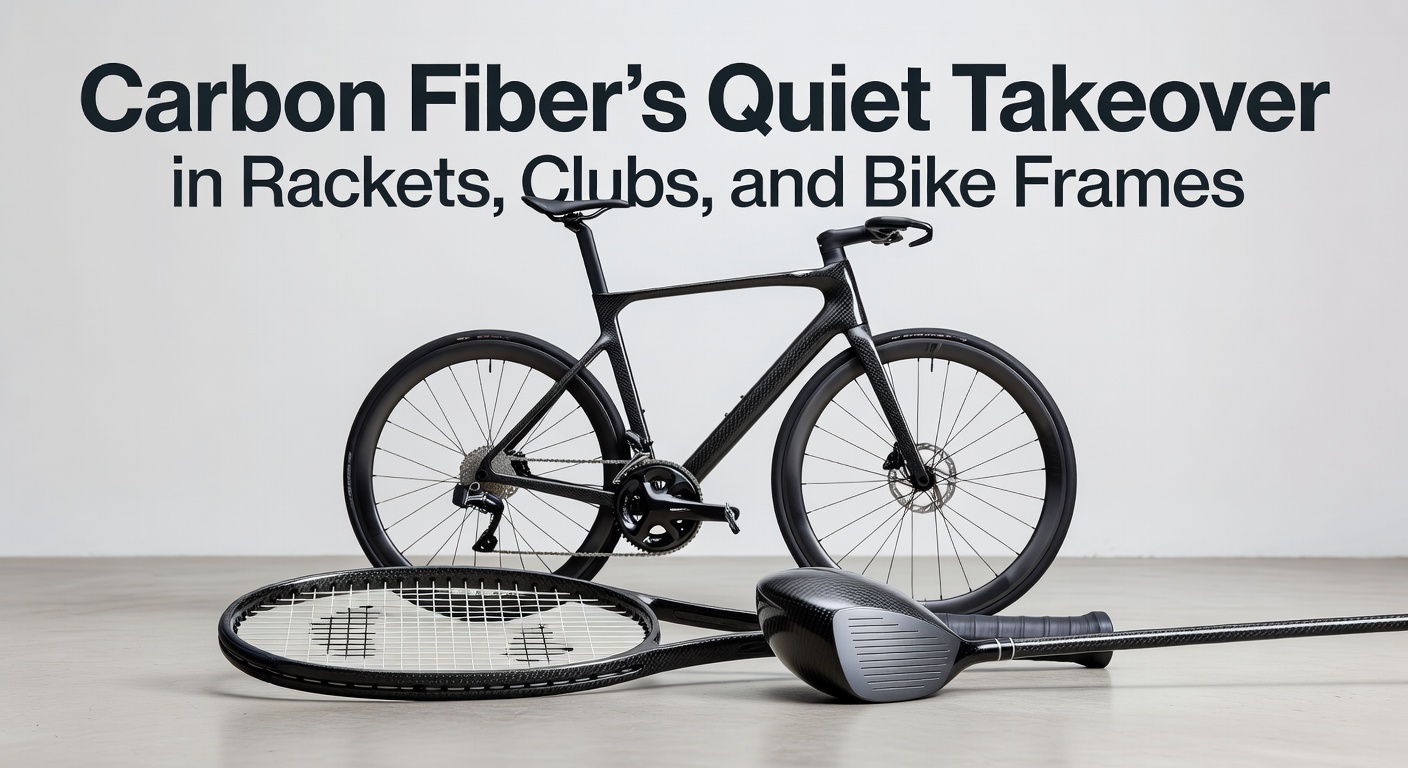
Carbon Fiber's Quiet Takeover in Rackets, Clubs, and Bike Frames
The Shift Toward Lighter, Stiffer Materials in Sports Gear
Carbon fiber composites have woven their way into the heart of high-performance sports equipment over the past few decades, transforming rackets, golf clubs, and bike frames in ways that prioritize strength without added bulk; athletes now swing, strike, and pedal with gear that's often half the weight of older models yet holds up under extreme forces. This material, made from thin strands of carbon atoms bonded in crystals and embedded in resin matrices, offers a tensile strength up to five times that of steel while weighing about a quarter as much, which explains its appeal across racket sports, golf, and cycling. Data from the CompositesWorld industry report reveals that by 2025, over 90% of professional tennis rackets featured carbon fiber reinforcements, a trend that accelerated as manufacturers chased marginal gains in speed and control.
What's interesting is how this takeover happened gradually, without fanfare; wood and aluminum dominated for years because they were cheap and familiar, but carbon fiber's arrival in the 1970s changed the game, starting with experimental prototypes that pros tested in tournaments. Take the Wilson Pro Staff racket, an early adopter in the 1980s, which blended graphite—essentially carbon fiber—with fiberglass, slashing weight from 14 ounces to under 12 while boosting stiffness for flatter shots. Observers note that similar shifts occurred in badminton, where carbon fiber frames now flex precisely during smashes, allowing shuttlecock speeds exceeding 300 mph in elite play.
Carbon Fiber Reinvents Tennis and Badminton Rackets
In tennis, carbon fiber layers stacked in precise orientations create frames that resist twisting on off-center hits, a feature research from Loughborough University in the UK demonstrated through drop-weight impact tests showing 30% less energy loss compared to aluminum. Players who've switched often report feeling vibrations dampened instantly, which cuts fatigue during long matches; by April 2026, the Australian Open showcased rackets from brands like Babolat and Head, all with full carbon construction, where layup schedules—specific patterns of fiber angles—fine-tune beam stiffness for topspin-heavy baselines. Badminton rackets followed suit quickly, since the sport demands even lighter gear; Yonex Astrox models, for instance, tip the scales at 75 grams thanks to high-modulus carbon, enabling whip-like swings that pros like Viktor Axelsen credit for their power.
And yet, it's not just about lightness; carbon fiber's anisotropic properties mean engineers orient fibers along load paths, maximizing power transfer from stringbed to ball while minimizing frame deformation. Studies published by the International Tennis Federation indicate that modern rackets with carbon twill weaves return 5-10% more ball speed off the strings, a quantifiable edge in tiebreakers. Those who've dissected pro gear find multi-layered constructions, often 20-30 plies thick, blending unidirectional tapes for longitudinal stiffness and woven fabrics for torsional rigidity, all vacuum-bagged and cured under heat.
Golf Clubs Get a Carbon Boost for Distance and Forgiveness
Golf clubs embraced carbon fiber later, but by the 2010s, drivers and fairway woods featured carbon crowns that redistributed weight low and deep for higher launch angles; TaylorMade's Stealth line, launched in 2022, used 60-layer carbon faces that flexed more on impact, adding yards without exceeding USGA limits. According to USGA equipment standards data, carbon allows heads weighing 200 grams to achieve MOI—moment of inertia—figures over 10,000 g-cm², forgiving mishits that steel couldn't match. Shafts tell a similar story; carbon graphite hybrids replaced steel in irons and woods, dropping swing weights by 50 points while maintaining tip stiffness for accurate strikes.
But here's the thing: pros like Rory McIlroy select clubs with variable-modulus carbon, stiffer in the handle for control yet softer mid-shaft for feel, as finite element analysis from Titleist R&D confirms optimal energy transfer. Observers at the 2026 Masters noted how carbon-faced hybrids dominated fairways, slicing spin rates on long irons by 500 rpm compared to forged steel, which helps balls carry farther in thin April air. Even putters incorporate carbon inserts now, dampening sound and feel for truer rolls on fast greens.

Bike Frames: Where Aerodynamics Meets Endurance
Cycling saw carbon fiber frames explode in popularity during the 1990s Tour de France era, when Specialized's E5 bikes shaved 1-2 kg off competitors' steel rigs, letting climbers like Marco Pantani attack steeper gradients. Today's road frames, molded monocoque designs from Trek or Cannondale, integrate carbon layups with moduli from 200-600 GPa, balancing compliance for comfort over cobbles with rigidity for sprints; wind tunnel data shows tube shapes—kammtails and truncated airfoils—cut drag by 20% versus round profiles. Mountain bike frames push boundaries further, with Fox-tested carbon linkages enduring 100,000 flex cycles without delamination.
Turns out, the real magic lies in resin systems; epoxy-infused prepregs cure into seamless structures that pros ride at 50 kph descents, as UCI homologation tests verify through crash simulations exceeding 40G impacts. By April 2026, gravel bikes from Santa Cruz blended carbon with dropped seatstays for rear triangle flex, absorbing 15mm of chatter on chip-seal roads while stiffening under power—perfect for mixed-terrain races like Unbound. Riders who've upgraded often clock personal bests, since frames under 800 grams transfer watts directly to pedals without parasitic flex.
Technical Edges and Manufacturing Marvels
Across all three categories, carbon fiber delivers through metrics like specific modulus—stiffness per gram—that steel can't touch; a 300g racket frame withstands 500N string tension, bike tubes handle 10MPa hoop stress, and golf shafts flex 3.5 degrees dynamic loft without permanent set. Resin transfer molding and autoclave curing ensure void-free laminates, while nanotube-infused variants emerging in 2026 prototypes promise 20% toughness gains, per research from Australia's CSIRO materials lab.
So, manufacturers iterate endlessly; finite element models predict failure modes, letting designers stack 0/90/45-degree plies for balanced quasi-isotropic behavior. It's noteworthy that vibration damping—carbon's beta relative to aluminum—reduces arm pump in long bike stages or elbow strain from repetitive golf swings, as biomechanical studies from the University of Colorado quantify through EMG data.
Market Momentum and Hurdles Ahead
Figures from Grand View Research project the sports carbon fiber market hitting $1.2 billion by 2030, driven by Asia-Pacific production hubs supplying 70% of prepregs; tennis racket sales skewed 85% carbon by 2025, golf woods followed at 75%, and bike frames led with 95% adoption in pro pelotons. Yet challenges persist—high costs from Toray and Hexcel fibers keep entry-level gear steel-bound, while recycling lags, although EU mandates push thermoplastic matrices for regrindability.
People in the industry point out supply chain tweaks, like automated fiber placement robots, will drop prices 15% by 2027, opening doors for amateurs. One case stands out: Cervélo's 2026 gravel frame, priced under $4,000, uses recycled carbon from old F1 wings, proving sustainability scales.
Wrapping Up the Carbon Revolution
Carbon fiber's integration into rackets, clubs, and bike frames stands as a testament to materials science reshaping athletic performance, delivering quantifiable boosts in power, control, and endurance that pros leverage daily; as April 2026 events unfold—from clay-court swings to Tour de France climbs—this quiet takeover shows no signs of slowing, with innovations ensuring gear evolves alongside athletes who push limits. The data's clear: lighter, smarter composites redefine what's possible, one fiber at a time.